
A Visitor's Guide to Tiwanaku and Puma Punku in Bolivia
Explore the ancient ruins of a pre-Inca civilization to see celestial gateways, carved monoliths, and a sunken court with protruding tenon heads.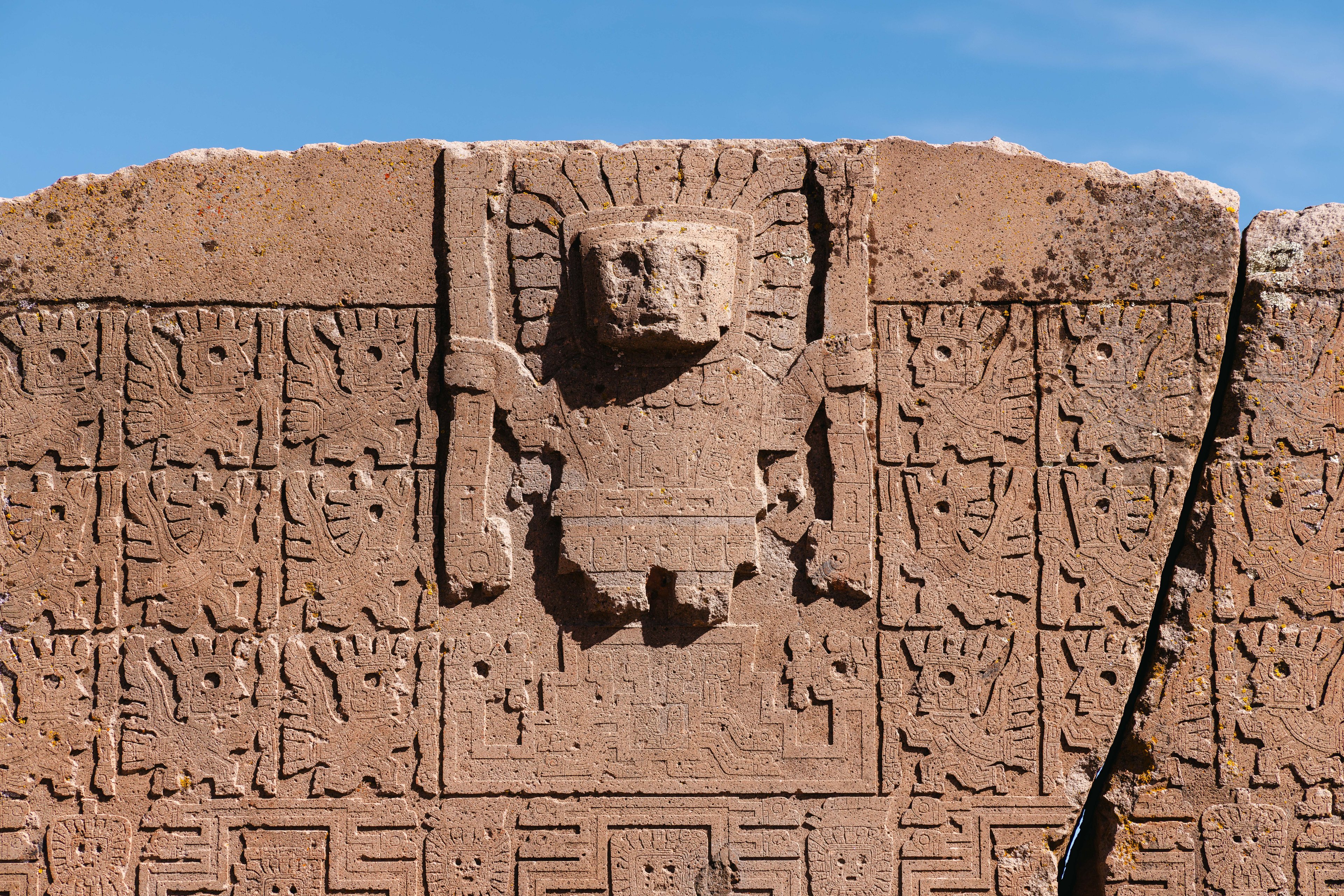
Stare into the wide eyes of revered gods immortalized in exquisite stone carvings, celestial gates, and towering statues. Question ancient engineering techniques as you behold strange H-blocks with precise cuts and geometric designs. Explore sunken and raised platforms with protruding heads and thick walls marking places of spiritual and cultural importance.
The archaeological sites of Tiwanaku and Puma Punku reveal a glimpse of a pre-Inca civilization on the western edge of Bolivia. An air of mystery continues to surround the people responsible for the construction of these fascinating structures and artifacts. The one-of-a-kind craftsmanship seems to defy all sense of logic and promises to entice curious travelers eager for adventure!

Logistics
The best time to visit the ancient ruins is during winter and the dry season (May-October). Expect clear skies, chilly temperatures, and windy conditions. Many Bolivians celebrate Aymara New Year, which coincides with the winter solstice on June 21st, at Tiwanaku. Shamans perform rituals and give offerings, such as coca leaves, to the sun god Inti and Earth goddess Pachamama. Traditional music and dances are performed all night until the sunrise illuminates the Ponce Monolith through the Doorway of the Sun.
Luckily, crowds aren't a problem at Tiwanaku and Puma Punku. Try to go during the week and early in the morning for a chance to have the complex all to yourself. Brad and I were the only tourists around for at least an hour. Tickets, which include entry to the archaeological sites and museums, cost $14 USD per person. Bring local currency since credit cards aren't accepted. Opening hours are every day, 9:00 AM-4:00 PM.


Planning a day trip from La Paz, the capital city of Bolivia, is extremely easy! Most travelers either join a group tour for convenience or use public transportation to save money. Since Brad and I prefer to roam ancient ruins at our own pace without a strict schedule, we opted to hire a round-trip private taxi via Aerotaxi for $65 USD. Our punctual driver was easygoing and waited for us to finish at the main entrance. Depending on traffic and road conditions, the ride takes two hours or less.
The archaeological sites are DIY friendly with plenty of informational placards in English/Spanish scattered throughout. The Ceramic Museum and Tiwanaku Site Museum showcase exceptional artifacts including painted ceramics, bone fragments, stone pumas, and a mummy. Don't miss the Bennett Monolith, the largest statue discovered in the Andean region, which weighs 70 tons and stands 7.3 m (24 ft) tall. Unfortunately, photography is prohibited inside of the museums.


Helpful Tips
The village of Tiwanaku is pretty quiet with only a handful of restaurants. I highly recommend packing a lunch with plenty of water and snacks, especially if you decide to visit without a guide. Bathrooms are located inside of the museums, but carry some facial tissues and hand sanitizer just in case. Keep in mind toilet paper isn't flushable in Bolivia.
There are a few vendor stalls by the main entrance if you want to shop for souvenirs. Wear sunglasses, sunscreen, and a hat since shady spots are hard to come by in the complex. The high altitude and sun can be intense, so stay hydrated and walk at a leisurely pace. Marked trails, arrows, and rope barriers make it easy to find your way around.

History
Tiwanaku was inhabited as far back as 300 BC, but the civilization reached its height between 500-1000 AD. Approximately 10,000-20,000 people lived in the area during this thriving period. Despite the arid landscape and harsh climate, farmers utilized a sophisticated raised-bed agricultural technique to optimize food production. Growing crops (quinoa/beans), raising livestock (llamas/alpacas), and catching fish at nearby Lake Titicaca sustained the population. This stability led to urban expansion, ambitious construction projects, and a rise in material culture.
Without a written language to decipher, scholars rely on the physical remnants of Tiwanaku to understand its population and society. The design of the ceremonial sites of Tiwanaku and Puma Punku reinforces the connection to the Yaya-Mama Religious Tradition and nature. Key examples are the early stelae, low reliefs depicting deities, evidence of human sacrifices, and use of snuff trays to consume hallucinogens. Many structures symbolize the surrounding geography such as the deep drainage canals which resemble flowing rivers.


Tiwanaku shared similar iconography with the neighboring Wari civilization and regularly traded with it to boost the economy. Eventually, the prosperity of the Tiwanaku civilization took a turn for the worse. A devastatingly long drought ravaged its vast territory, which caused the people to abandon the city around 1100 AD. Centuries later, the Inca Empire adopted many aspects of the Tiwanaku culture including agricultural practices, building techniques, and spiritual ideology. The Inca believed the ancient city was the birthplace of the gods and considered it a special pilgrimage destination.

Tiwanaku
The religious zone of Tiwanaku was separated from the rest of the city by a moat, which may have represented the Isla del Sol in Lake Titicaca. Ornate pieces of gold and silver metalwork were found on the island. According to legend, the creator god Viracocha emerged from the lake to share knowledge with humanity. The badly eroded Akapana Pyramid is the massive centerpiece of the man-made island.
Seven stacked terraces, filled with rubble and dirt, were contained by sandstone walls to form one half of a chakana (prominent cross symbol in Andean cosmology). Each level was covered with teal gravel to signify the force of life and honor the surrounding mountains. A sunken court in the shape of a chakana functioned as a water reservoir at the summit. Residential foundations to house elites remain on the northeast and southeast corners.


Descending the stairs into the Semi-Subterranean Temple is an enigmatic moment! Bulbous tenon heads and their haunting eyes seem to watch your every step in the rectangular sunken court. Each face is unique and may portray a mythological figure or local elite. Three Yaya-Mama style stelae with human characteristics and animal carvings stand in the middle. The Bennett Monolith was also found here during excavations. Its intricate depictions of ceremonial dress and sacred items, such as the snuff tray and qiru (cup to drink the fermented corn beverage known as chicha), bedazzle admirers.


The spacious Kalasasaya is a low platform mound enclosed by a reconstructed wall of huge sandstone pillars and blocks fitted together using ashlar masonry. The structure is oriented to the cardinal directions and some megaliths are positioned to mark recurring astronomical events including the equinoxes. The imposing Doorway of the Sun aligns with the Ponce Monolith, which is decorated with fantastic carvings and symbols. The nearby Fraile Monolith represents a priest who wears a belt of peculiar plants, which are commonly mistaken for crabs.


The star attraction of Tiwanaku is undoubtedly the Gate of the Sun! This breathtaking ceremonial doorway was carved from a single block of andesite and weighs approximately 10 tons. Dozens of winged attendants with human and avian heads face and flank Viracocha in the center. A radiating headdress adorns the powerful god who holds two thunderbolts. The bottom section of the frieze may show a calendar with agricultural seasons and cycles of the sun/moon.


Puma Punku
Built during the 6th Century AD, the ancient ruins of Puma Punku are simply extraordinary. The T-shaped platform mound had three levels of stone retaining walls which were surrounded by courts and pathways. A haphazard collection of bizarre stones, fallen gateways, and red sandstone slabs remain at the summit. Some of the lintels have tiny pin holes used to secure gold and precious stones. The glittering effect surely enhanced the spiritual ambience of the complex.

The odd andesite H-blocks at Puma Punku were engineered to interlock with one another to possibly form blind miniature gateways. Expert linear cuts, equidistant shallow holes, right interior angles, curved lintels, and polished surfaces continue to baffle scholars. A durable bronze alloy made out of copper, nickel, and arsenic was cast into I-shaped cramp sockets to hold some stones together. The tools and techniques used to create this mind-boggling marvel are still unknown.


Overall Experience
History is often explained through a modern lens to help understand bygone civilizations. Priceless artifacts are often lost, but traces remain to unravel the threads connecting to the past. Facts turn into legends and symbols lose meaning, but stone withstands the threat of time. Thankfully, the innate human desire to leave a lasting legacy contributes to the continuously evolving archaeological record.
The sacred sites of Tiwanaku and Puma Punku dare visitors to think outside the box. The puzzle pieces may be scattered, but that doesn't obscure the impressive ingenuity. However you interpret these influential structures and carvings is up to you, but I promise these wonders of Bolivia will change the way you think about ancient technology!
