
Easter Island: A Remote Oasis of Monolithic Ancestors
Take a once-in-a-lifetime trip to Easter Island to see ancient moai, go scuba diving in the Pacific Ocean, and learn about Rapa Nui culture.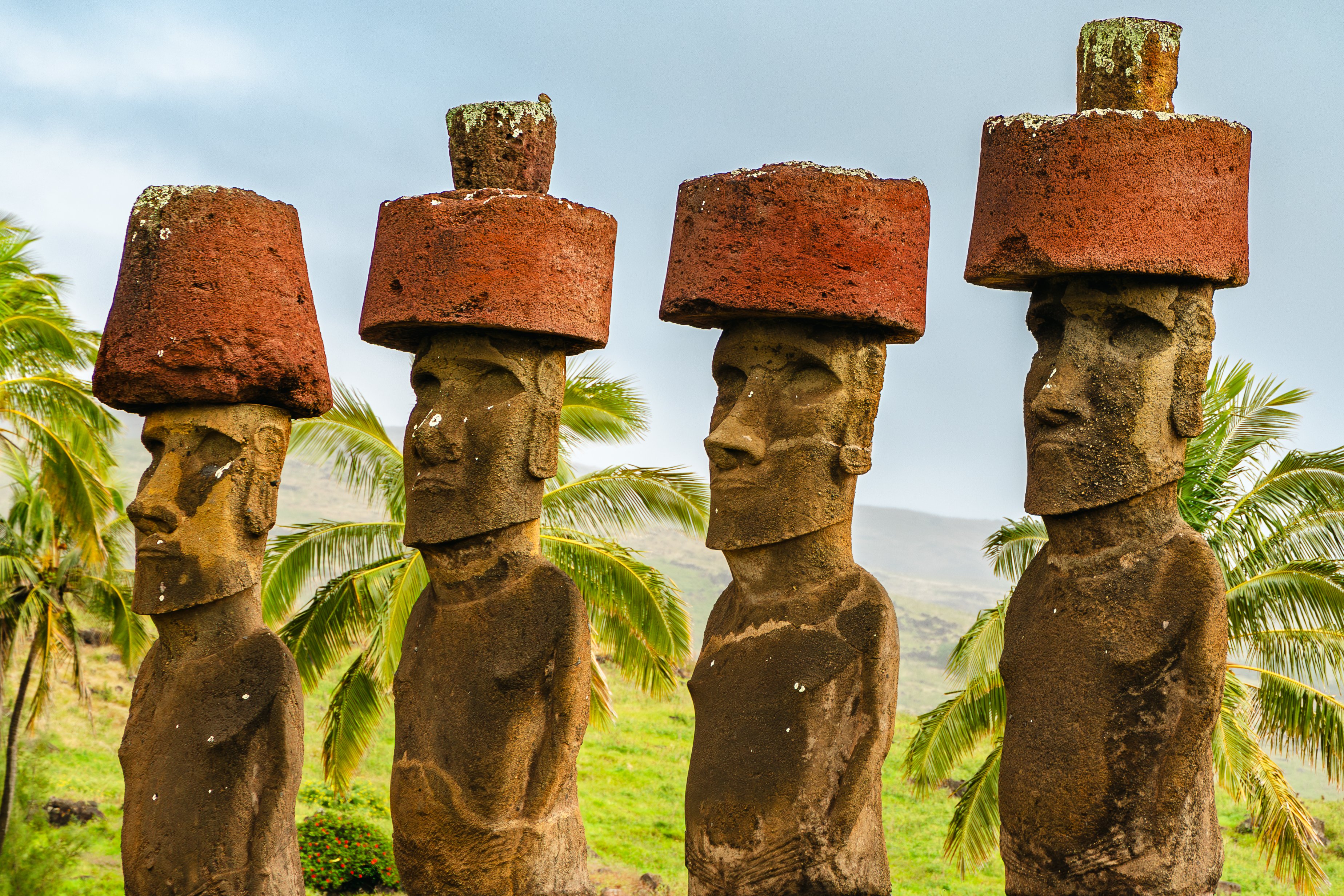
In the middle of the Pacific Ocean lies a magical island full of mysterious wonders. Towering moai with stoic faces act as guardians to protect the native heritage of the Rapa Nui people. While dozens of these resurrected stone giants reside on platforms lining the rocky shore, most remain scattered, toppled, and partially buried. Whoever ventures to Easter Island is bound to discover its alluring legacy by appreciating these one-of-a-kind monuments.
In addition to admiring the magnificent moai, travelers can also experience activities such as musical shows, scuba diving, trekking, sea turtle watching, and stargazing. Brad and I packed as much as possible into our four full days on Easter Island. Below I cover logistics, restaurants, our two-day excursion with Green Island Tours, things to do, and a bit of history to help plan your itinerary to one of the most epic destinations in South America!


Logistics
The best time to visit Easter Island is during the shoulder season (September-December and April-June). You'll encounter fewer crowds, lower prices, occasional sprinkles, and plenty of available tour operators. Brad and I enjoyed decent weather during our trip in early June 2025. Rain showers, strong winds, and chilly temperatures are pretty much guaranteed during the low season (July-August).
High season (January-March) has the warmest temperatures and biggest crowds. The Tapati Festival, a two-week cultural celebration in February, is the highlight of the year! Locals and tourists can participate in athletic and artistic events, such as banana trunk racing and body painting. Be sure to book accommodations and flights well in advance if you plan to attend.

The easiest way to reach Easter Island is via a LATAM Airlines flight out of Santiago, Chile, to Mataveri International Airport (IPC). Typically, there are only one or two direct flights daily. Check the website for up-to-date departure and arrival schedules. All visitors must complete the online Single Entry Form (FUI), show proof of a round-trip airline ticket within 30 days, and have reservations at a certified SERNATUR hotel. Once approved, officials will issue you a paper voucher which you'll need to board the plane.
The small airport on Easter Island is within walking distance of Hanga Roa (main town), but taxis are also available if you want a lift. There are plenty of places to stay with varying price points. Brad and I opted to rent a spacious apartment at the Matariki Sunset Apart Hotel nearby the coast. The central location, comfortable bed, balcony with ocean view, and friendly staff were topnotch!


Perhaps the most important aspect of your trip is buying a Rapa Nui National Park ticket ($80 USD per person) to access the sites around Easter Island. The digital ticket is valid for 10 consecutive days starting from the entry date selected at the time of purchase. Print, download, or screenshot your ticket since signal in the park is unreliable. A passport is also required at site checkpoints.
Excluding the sites of Ahu Tahai and Anakena Beach, visitors must be accompanied by a certified local guide to visit Rapa Nui National Park. Contact your hotel for options, research companies online, and read reviews to find your ideal companion. I highly recommend the Small Group Combo Deal Three - Two Full Day Tours with Tongaiki Sunrise and Stargazing package ($395 USD per person) with Green Island Tours. Even though we didn't book a private tour, we had our laid-back guides, Hekii and Yo Yo, all to ourselves!

Hanga Roa
Positivity and tranquility meld together in the eclectic town of Hanga Roa. Sidewalks are lined with hibiscus blossoms, cafés, colorful murals, boutiques, eateries, and residences. Modest grocery and convenience stores have plenty of snacks and supplies. There are a few bike, moped, and car rental agencies to help you explore the island. Head to Pea Beach to take a refreshing dip in the blue water or watch sea turtles breach the surface.


Stroll around the Artisan Market and Handicraft Fair to find neat souvenirs including mini moai figurines, paintings, keychains, canvas bags, t-shirts, and wooden decor. I was thrilled to find a silicone moai mold to use for drinks and desserts! Tourism is a major part of the economy and purchases help support the locals. Say iorana if you want to make a good impression, which means hello/goodbye/welcome in the Rapa Nui language.


Brad and I also bought three affordable moai figurines from the vendors next to Ahu Tahai. Tables of treasures are set up every night for the sunset rush. The area is the best place to kick back, relax, and soak up the grandeur of Easter Island before dinner. Don't be surprised if a stray dog sits next to you and asks for a few pets!


Restaurants
Hanga Roa has plenty of tasty al fresco restaurants with fresh seafood and fruity drinks. Toast your adventure on Easter Island with a round of creamy piña coladas at Kanahau, which was our favorite spot for the blended cocktail. For lunch, try the made-to-order shredded beef and tuna empanadas packed with flavorful ingredients at Nená's Specialty Coffee. Brad and I were blown away by the big portions!
Always come hungry for dinner! Jumpstart your taste buds with a hearty plate of ceviche made with raw tuna, red onion, ginger, and lime at Makona Restaurant. The bowl of tangy ceviche and grilled fish of the day with mashed potatoes and mushroom roquefort sauce at Oheho Surf Cafe were mouthwatering meals. If you crave a slice of comfort food, devour a chewy wood-fired margarita pie with pesto and arugula at La Pizzeria.


Green Island Tours
Brad and I booked the Moai Monuments tour, Stargazing tour, Historic Pathways tour, and Tongariki Sunrise tour with Green Island Tours. The comprehensive package with shuttle transportation was a hassle-free way to enjoy our once-in-a-lifetime trip to Easter Island. Our knowledgeable and enthusiastic local guides, Hekii and Yo Yo, told us about Rapa Nui history, moai symbolism, island geography, agricultural techniques, petroglyphs, and cultural activities as we explored the following sites.

Moai Monuments Tour
According to oral legends, Polynesian chief Hotu Matu'a and his captain Tu'u ko Iho sailed across the sea in wooden catamarans to establish settlements on Easter Island. Sometime before the 12th Century, they landed on the white coral sand of Anakena Beach. Fishing and farming sustained the population, which reached approximately 15,000 inhabitants at its peak.
Anakena Beach has two ahus (stone platforms made of lava rocks, basalt, and rubble). Ahu Nau Nau has seven moai, some of which feature elaborate carvings and pukao (topknots carved from red volcanic scoria). The lone moai of Ahu Ature Huki was the first to be re-erected on the island using ancient techniques during an archaeological expedition in the 1950s.


The Navel of Light, a magnetic circular stone brought by Hotu Matu'a from his ancient homeland of Hiva, contains mana (supernatural energy) and healing powers. Ahu Te Pito Kura has the tallest moai ever finished, which remains in a toppled state. Approximately 900 statues were produced on the island with an average height of 4 m (13 ft) and weight of 12.5 metric tons!


The production of moai was a pinnacle achievement of the Rapa Nui culture. Rano Raraku was the main quarry from where these megaliths of volcanic tuff were carved and transported to different ahus on Easter Island. Hundreds of oversized heads with heavy brows, thin lips, elongated ears, sharp noses, and chiseled chins haphazardly rest on the grassy hillside. The Tukuturi moai is a special anomaly due to its kneeling position, realistic human physique, and resting hands on the thighs.


Moai were usually erected on linear platforms next to coastal villages to honor ancestors and chiefs. As long as these spirits were given offerings and respect to ease their journey in the afterlife, living descendants would receive vitality and bountiful harvests. Restored in the 1990s, Ahu Tongariki is the most breathtaking platform with fifteen massive moai, one of which weighs approximately 86 metric tons. This ahu perfectly aligns with the rising sun during the summer solstice. Several nearby petroglyphs depict zoomorphic imagery and human faces.


During the 18th Century, clan warfare resulted in the destruction of erected moai as a way to demoralize enemies and their ariki (high chiefs). According to cultural beliefs, the mana within each statue would disappear once broken. Ahu One Makihi is a harsh reminder of this turbulent period of Rapa Nui history. Now time and weathering threaten to erode what is left of these moai and ahus.

Stargazing Tour
Marc, the owner of Green Island Tours, hosts a wonderful stargazing session on Easter Island. Our group learned about astronomy principles, Polynesian sea navigation, and Rapa Nui legends under the night sky. We sipped hot cocoa and ate cake while taking turns observing stars, constellations, and the Milky Way Galaxy through high-powered telescopes. The high-definition view of the Moon and its craters was a highlight!

Historic Pathways Tour
The seven moai of Ahu Akivi represent the first seven settlers who came to Easter Island. Their slender bodies and similar attributes convey equal status. Unlike other statues, these inland moai face the Pacific Ocean in order to provide safe passage for Rapa Nui sailors. This ahu also precisely aligns with the spring and autumn equinoxes.

A few moai on Easter Island are crowned with red pukao, which represent the topknots (hair) of clan chiefs. The sacred color evokes mana and the vital force of life (blood). Pukao were carved out of lightweight volcanic scoria from the quarry of Puna Pau. Between the 15th-16th Centuries, these circular motifs were later added to certain moai to enhance reverence.


The ashlar masonry of Ahu Vinapu is a bewildering example of Rapa Nui engineering. Huge slabs of basalt were carved and positioned without mortar, similar to the techniques used by the Inca civilization at Saqsaywaman and Qorikancha in Cusco, Perú. The impressive stonework could suggest a shared knowledge or relationship between the two cultures. Countless scattered pieces of moai, including a rare female moai with a missing head, surround the platform.


Spectacular scenery is guaranteed at Rano Kau, a deep crater of an extinct volcano with fertile marshland and freshwater lagoons. The uphill climb to the mirador (viewpoint) is worth the effort to see a panoramic vista of Easter Island! The nearby ceremonial village of Orongo has restored windowless stone buildings with sod roofs. Multiple petroglyphs portray significant iconography such as Make Make (creator of humanity) and Tangata Manu (sacred birdman champion).

Between the 18th-19th Centuries, Orongo was the center of the Birdman Cult. Every year, men would compete in a dangerous race by descending the rocky cliff face to the shore and swimming to the islet of Motu Nui to retrieve a Sooty Tern egg. Whoever returned first would become the next Tangata Manu and tribal leader of Easter Island. A grand festival with music, feasts, and dancing would honor the victor and his clan.


Tongariki Sunrise Tour
Rise and shine! A trip to Easter Island would be incomplete without watching a sunrise at Ahu Tongariki. Brad and I saw hues of purple, pink, orange, and yellow paint the sky above the moai silhouettes. Hearing the waves explode against the shore as the sun rose over the cliffs and clouds was an ethereal moment. It's a remarkable way to start the day!

Scuba Diving
Switch up your perspective with a fun scuba diving excursion to see an underwater moai replica resting against a coral reef. Brad and I couldn't resist swimming next to this concrete movie prop in the Pacific Ocean! We booked a single dive with Mike Rapu Dive Center, which I highly recommend for its great equipment and friendly staff. We also saw two anchors, scorpionfish, and schools of Yellowfin Goatfish in the crystal-clear visibility.
Kari Kari Cultural Ballet
Grab a front row seat at the Kari Kari Cultural Ballet to experience a riveting performance that may move you to tears! Brad and I were captivated by the hypnotic dancing, energetic melodies, traditional clothing, and rhythmic instruments. We actually felt the beautiful mana of the joyous group, which helped us connect with the Rapa Nui culture in a way we didn't expect. Beforehand, we ate a delicious four-course meal with authentic dishes and fruity cocktails in the adjacent restaurant. What a night!


Helpful Tips
Easter Island has a warm subtropical climate, but the strong winds can be brisk. Bring a rain jacket or sweater for the cool mornings and evenings. Lightweight athletic clothing will help you stay comfortable in the heat and humidity. Hiking boots are ideal for the uneven and muddy terrain. Don't forget sunscreen, insect repellent, your favorite Hawaiian shirt, and a swimsuit!
Keep in mind the ancient sites are sacred and need to be treated with respect. Walk on designated trails, pay attention to stone barriers, and never touch the moai. Please take out what you take in and leave no trace, including biodegradable food which can harm the ecosystem. Drones and smoking are prohibited in Rapa Nui National Park.


Final Thoughts
Standing face to face with the moai of Easter Island is a bucket list experience. To marvel at these colossal stone spirits on their volcanic altars is truly indescribable. Hollow eyes hint at a lasting legacy forged out of the determination of their descendants. Even after facing exploitation, religious conversion, disease, and slave raids during the 19th Century, the resilient Rapa Nui people held onto their identity against all odds.
As I watched the fiery sunset at Ahu Tahai on our final night, I pondered the ripple effects of this dark chapter in history. The Rapa Nui people survived a tragic past and almost lost their unique culture. Now all generations keep the mana of their ancestors intact by protecting their homeland and way of life. You can almost hear the encouraging whispers of these enduring spirits with each crashing wave on this isolated Polynesian island full of supernatural energy.
